My brother phoned me on June 13th, 2025. I was driving my oldest son to his weekly PT. I probably wore leggings and a soft tee. Maybe a loose sundress. I should tell you, my brother rarely calls. When I say “rarely,” I mean, like once or twice a year. I should also tell you that my brother and I love each other. We just don’t talk often. I should also tell you, I rarely talk on the phone.
I answer his call.
I’ve bad news, he says.
OK, I say.
Mom died.
I didn’t expect that, I say. I might’ve exhaled first. I don’t remember.
I do remember, pulling over into a gas station, worried that I would begin to cry. I didn’t. Cry, that is.
Her funeral’s next week, he says, and, I’m going.
I don’t know that I’ll attend, I say, and, Can you send me the details, just in case?
Sure. I’ll send you what I found on line.
Thanks.
I’ll call Ava (my mother’s sister), he says, and, I already told Julian (my mother’s brother).
Thank you, I say, and, I don’t know how I feel.
Understood, he says, and, I love you, Sister.
I love you, Brother.
I pull back into our drive, turn to my son, and say, Give me a minute, because he was in the middle of unpacking a new scene he’s writing when the call came.
I wait a day and send a text to some of my friends:
I’ve not shared this news with anyone. I’m still processing. My brother phoned to let me know our mother passed. As you know, I’ve had no relationship with her since I left home at 14. Still, the matters of our hearts are so complex. I will be sitting shiva for a week in hopes of healing, her and me. This means I will be home in reflective space. If you’d like to come with food or love or hugs, that is tradition. If I’ve not expressed my gratitude for you enough, my apologies. Much, much love. R
What I didn’t know, because I’d yet to talk to my Rabbi, is that I wasn’t going to sit shiva. Not traditionally.
What I noticed, were the friends who responded. Some with kind thoughts. Some with calls. Some came with comfort food of noodles and bread and wine. Some did not respond, which is a response. Maybe they didn’t know how.
If you’ve read Tangled by Blood, my first collection, a memoir in verse, you know the harmful impact of my mother’s non-protection of me as a child. It’s complicated to respond to me, I’m sure, regarding my mother, my childhood, my assaults.
It’s also very likely that it’s just complicated to respond to me.
When I talked to my Rabbi, he asked, When did she die?
I’m not sure.
We need to know. We need to know how long she’s been gone. We need to know if her body has been cremated or not. If it has, you cannot sit shiva.
I should mention, I don’t know how to sit shiva. I’ve never sat shiva. My mother did not raise me Jewish. I usually say, She raised me quite confused.
While serving in the military (forty years ago), I studied a variety of spiritual paths, including Taoism, Buddhism, and Christianity. Judaism, or more specifically the esoteric underbelly of Kabbalah, stuck. I’ve woven in other practices over time, like moon bathing and crystal energy. I’ve woven in methods to heal, ways to balm my heart.
It takes three more calls between my brother to learn that she died on May 23rd. To learn that no one knows if her body has been cremated.
I’ve probably sat shiva long enough, I tell my Rabbi.
He’s quiet. He holds space.
I continue, I mean, I think I mourned the loss of my mother before I entered the school system. When she witnessed her husband, my stepfather, sexually assaulting me. I was not even five.
Quiet.
Or maybe when I fled home at 14 or 15. And she told me that any man is better than no man, when I told her after ten years of rape, I could not stay anymore. I told her this at the diner she waitressed. I can’t remember if I had my lawn bag with me. The bag I filled with Levi’s and 8-tracks and my track spikes.
Quiet.
Or maybe later, at her mother’s funeral. I was 32 or 33 and hadn’t seen her since I left. And here, she waltzed around pretending she knew me, pretending she had some bond or something. I pulled her aside, told her that I’d love to have a mother but we would need to acknowledge the damage…
She held her hand up, Stop, it said. Then she said, If that’s what you need then I need to wash my hand of you.
That was it. The official, End.
Quiet.
Somewhere before the age of five and my grandmother’s funeral, I sat shiva over the loss of my mother. Shiva looked like eating disorders and dating and marrying inappropriate partners and drinking shots of tequila chased by Bloody Mary’s. I didn’t know I was sitting shiva. Didn’t know I was mourning. I thought I was living and nearly dying through starving and suicide attempts. I thought watching destruction during the war catapulted me into a deeper death.
Quiet.
How many times can you die? Or sit shiva for another? I ask my Rabbi.
Here, 29 years after my grandmother’s funeral, and now, she, my mother, has left her body.
You can be thankful she is no longer suffering, my Rabbi offers.
Now I’m quiet. Oh! How much she probably suffered. How much those who bring suffering are also in pain. I don’t know what to do with this thought. I set it aside. For now.
What do I do while sitting shiva? I ask.
IF you can sit shiva, he reminds, and, the goal is to find good memories. To allow her memory to be a blessing.
I have none. I have nothing, I say.
You’ll think of something, he says.
We never find out if my mother was cremated or not, so I sit un-shiva and pen in my journal.
I call my brother.
Do you have good memories of Mom? I ask.
We always had food. She worked hard as a waitress, he says.
At more than one place, I say.
Quiet.
Thanks, I say.
I love you, Sister.
I love you, Brother.
Someone, I still don’t know who, sent flowers.
When the flowers begin to wilt, but still hold color, I clip the stems and leaves and “stencil” watercolor onto pages.
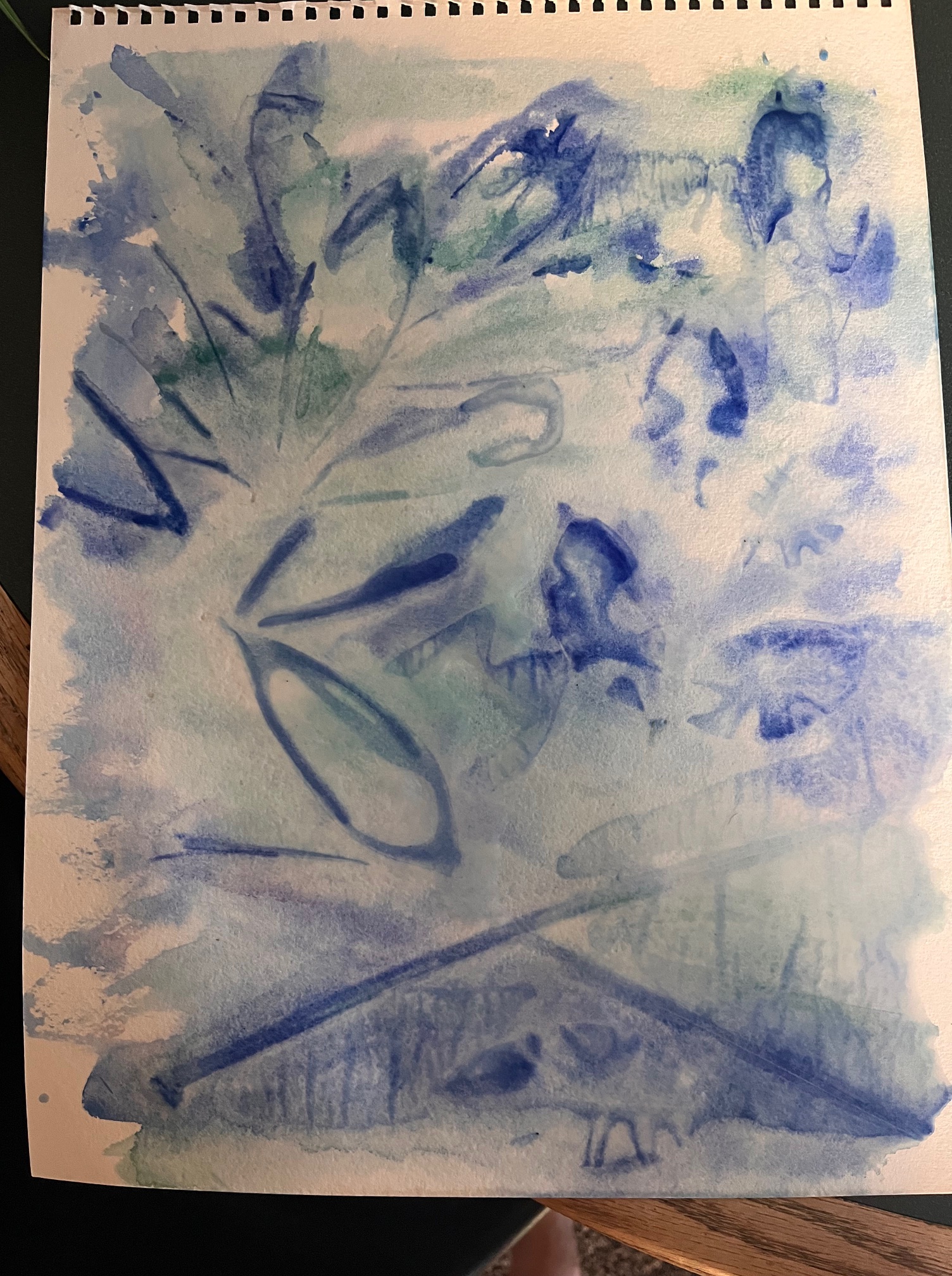

I’ve not worked with foliage and watercolor. I’ve not turned foliage into art, unless you count my backyard, my fruit trees, my gardens. I’m not sure why I’m making art with flowers for my mother’s death from an unknown, yet caring, person.
I’m not sure why I don’t ask my list of friends, Did you send the beautiful flowers for my mother?
I save the flowers. I press them between wax paper and place in collected cookbooks: Moosewood, 52 Shabbats, and Fire + Wine. I don’t know why I’m saving them. I’m not sure what I’ll do with them. My plan was to cut the watercolor stem stencil pages into bookmarks and gift them.
I don’t.
I’ve tried to journal about un-shiva-ing each day since the call from my brother. This practice has churned into an interrogation of mothering. I wonder if I’m a good mom. I wonder how my mom felt (if she felt) about her mothering/non-mothering ways. I sort through this in my journal, in my garden, in my dreams.
By now, I’ve purchased modge podge and cheap brushes and art tweezers. I purchased these, not for the flowers, but remembering a friend’s dresser, circa 1999. She’d completely coated the furniture in cuttings and images and paint. I loved the whimsy. Loved the idea. I’ve thought about this type of curation a lot since then and have wished to apply this to my lessons with my high schoolers in the Juvenile system.
Last night, a friend visits. Our plan was to “work.” When I say work, I mean the business side of art. But I’m tired and I tell her, I want to create something beautiful. She smiles. She nods. She’s like that.
She works until her laptop battery runs dry.
I interrupt her.
I’m making some sort of modge podge collage from the bouquet of flowers for my mother when she died, I say.
I think I’ll make two. Use both sheets of watercolor prints, I say.
I’ll give one to my brother, I say.

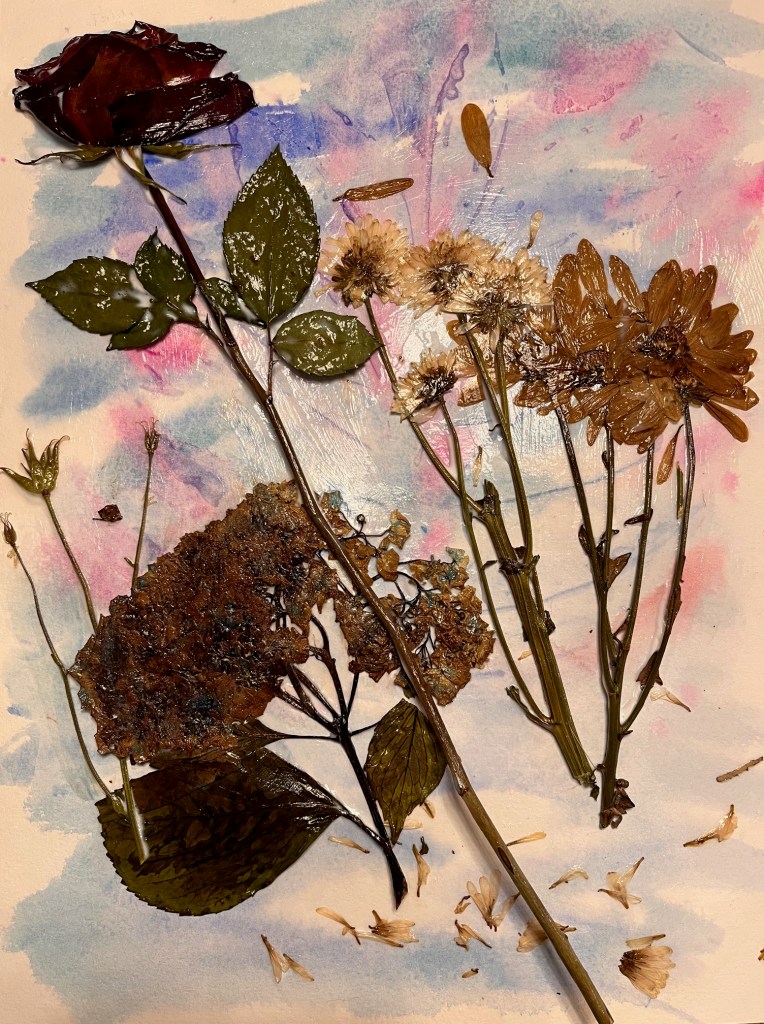
I practice modge-podging on a smaller sheet of watercolor paper.
It works.
I like the way the flowers are dead and preserved at the same time. Like the way they’ve textured the paper. Like how there’s some fur-fuzz from my Newfoundlands who are standing by.
I podge. I modge. I need the tweezers to put flowers back together. I leave petals to fall where they will, like in my garden. Like in my heart.
I make one.
I’m surprised by the way the rose still holds her hue.
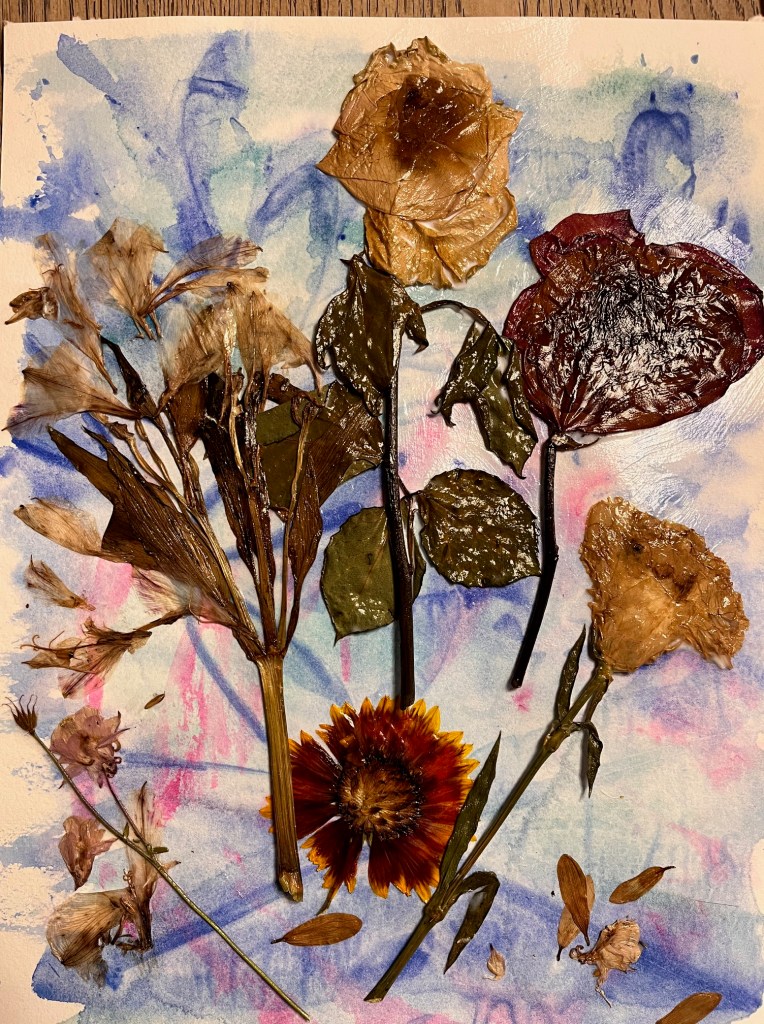
I make the other.
Here, my friend turns the rose for me. I didn’t see how I had the front face-down and I wonder how many times something in my life has sat this way without my noticing.
I don’t know if my brother will like the art. Here, my way of creating a soft memory where none exists. I don’t know if he’ll understand what I’ve tried to do. I do know that it doesn’t matter.
After my friend leaves, after the pups fall to sleep, I stand beneath the Full Blood Moon and empty my hurt and some anger I that I thought I’d already released. I understand that my mother never did wash her hands of me. I understand the way her non-protection and her abandonment has curated much of my narrative arc. I understand that there is no “end” in relationships. Only movement. Forward or backward. We decide.
My un-shiva-ing is most likely also not over.
This, too, I understand.
Discover more from Rebecca Evans
Subscribe to get the latest posts sent to your email.

Rebecca, as I was reading, I wanted to crawl through the phone and hold you. Thank you for sharing, I’m so sorry and grateful to know wh
LikeLike
Barbara,
Thank you for reading, for replying, for sharing my moments here.
LikeLike
Th
LikeLike
I am proud to know someone so, so courageous. You’re in my heart and because you are my heart is simultaneously more open and stronger than it could ever be without your presence.
LikeLike
Thank you for the safe space in which you hold me. And thank you for reading and responding.
LikeLike
This was beautiful. I respect rituals of mourning, but struggle with dogma that dictates how it should be done. I think you found the perfect way. Thank you for sharing this, Rebecca.
LikeLike
Tomás. Thank you. I couldn’t agree more. Any entity that “dictates” the heart feels a struggle for me as well. The need to make sense and ritual is part of this human experience. Thank you for reading. Thank you for pausing and sharing your thoughts.
LikeLike
What a beautiful rendering (both the words and the art) of you listening to your heart. It is so interesting to me to watch, from afar, with only your words, your photos, your video. I will hold all of it in my own heart today, and quite likely beyond. Maybe like the small fragments, modged and podged and finding their place in the overall picture, which becomes my picture too. Thanks Rebecca.
LikeLike
Thank you for these words. This matters. Knowing that my expression leaves a beautiful imprint means so very much to me.
LikeLike
Such a lovely and raw sharing. Thank you.
LikeLike
Thank you for pausing to read and respond. It matters.
LikeLike
Beautiful, Rebecca. And very, very, hard. Min haShamayim Tenuhamu. x
LikeLike
…how much you know my journey, my friend…
LikeLike
This sounds like it was a beautiful way to move through and with the layers ready to go. 🖤 Sending love, and protection, past present future, for the journey.
LikeLike
It was a surprising way to navigate this wound. I’m thankful for the love. Thankful for you.
LikeLike
Life is collage -in living and in death- for better and for worse.
We curate our given days randomly and by choice.
Your journey is inspirational, Rebecca.
Your writing chills my bones and touches my heart.
Mothering is complicated.
Abuse is cruel.
Life, complex.
May we all merit a blessing.
LikeLike
What a beautiful and heart-full response. Thank you so much for your words and support. And yes, may we all merit a blessing.
Much love.
LikeLiked by 1 person
🕊A(wo)men! 🍎
LikeLike