
I taught a kintsugi art class in 2024. It went less than well, mainly because I nearly caught a few participants’ eyelashes on fire. I’ll come back to my fire-hazard moment. Let me back up: I’m not a kintsugi expert and this was my first and only kintsugi workshop.
For me, kintsugi began as a fascination and turned into a meditation, like many of my other artsy explorations. At my core, I’m a fixer. At my core, I long to help. My sons might tell you, She’s solution oriented, if you asked them how I manage challenges. I avoid words like “good,” “bad,” “problem,” and instead I auto-frame a situation as “opportunity.” Some of my most difficult experiences were truly opportunities for me to shine, to rise, to grow.
Kintsugi (and my, uhm, kintsugi workshop) turned into a great experience.
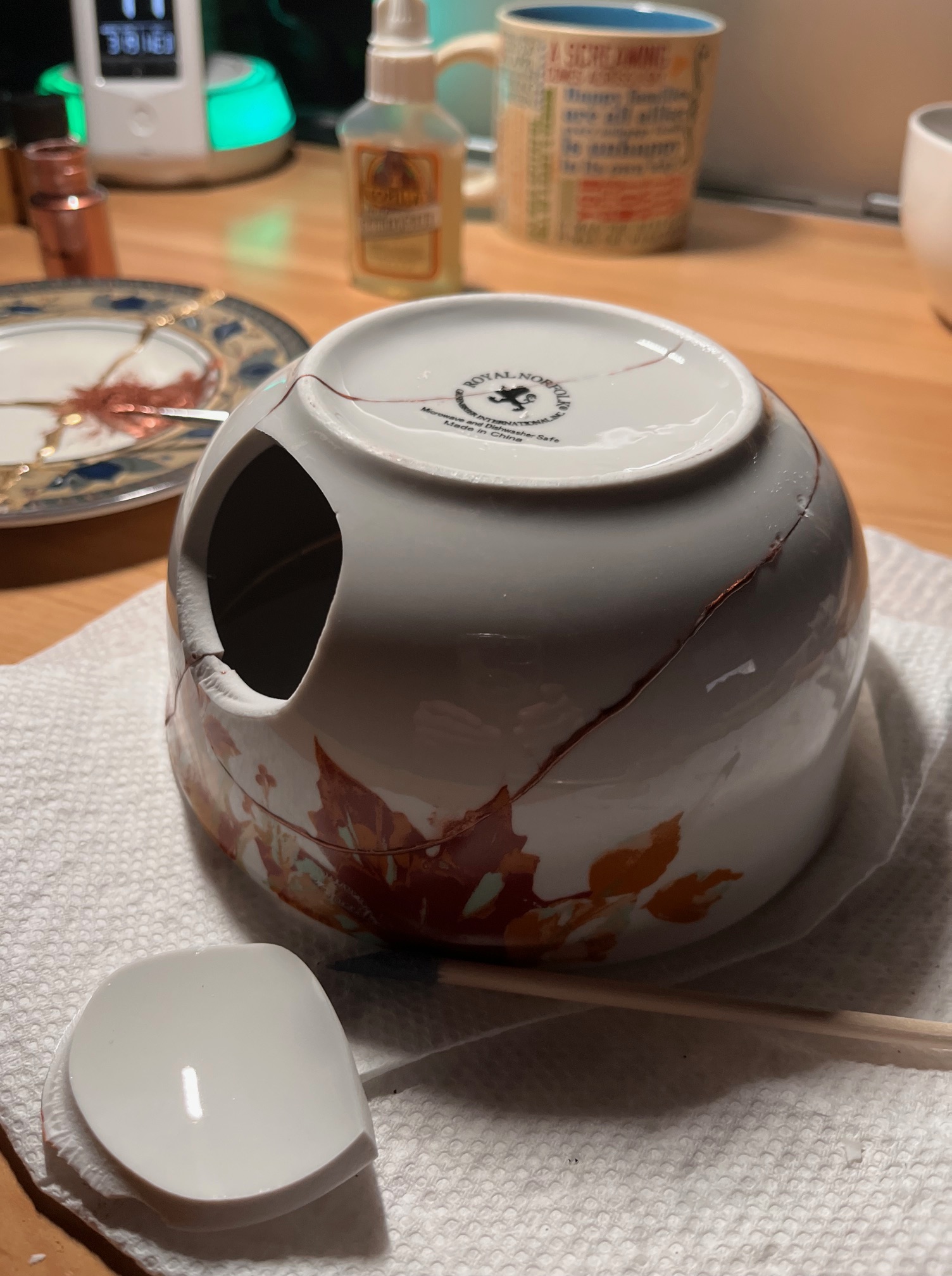
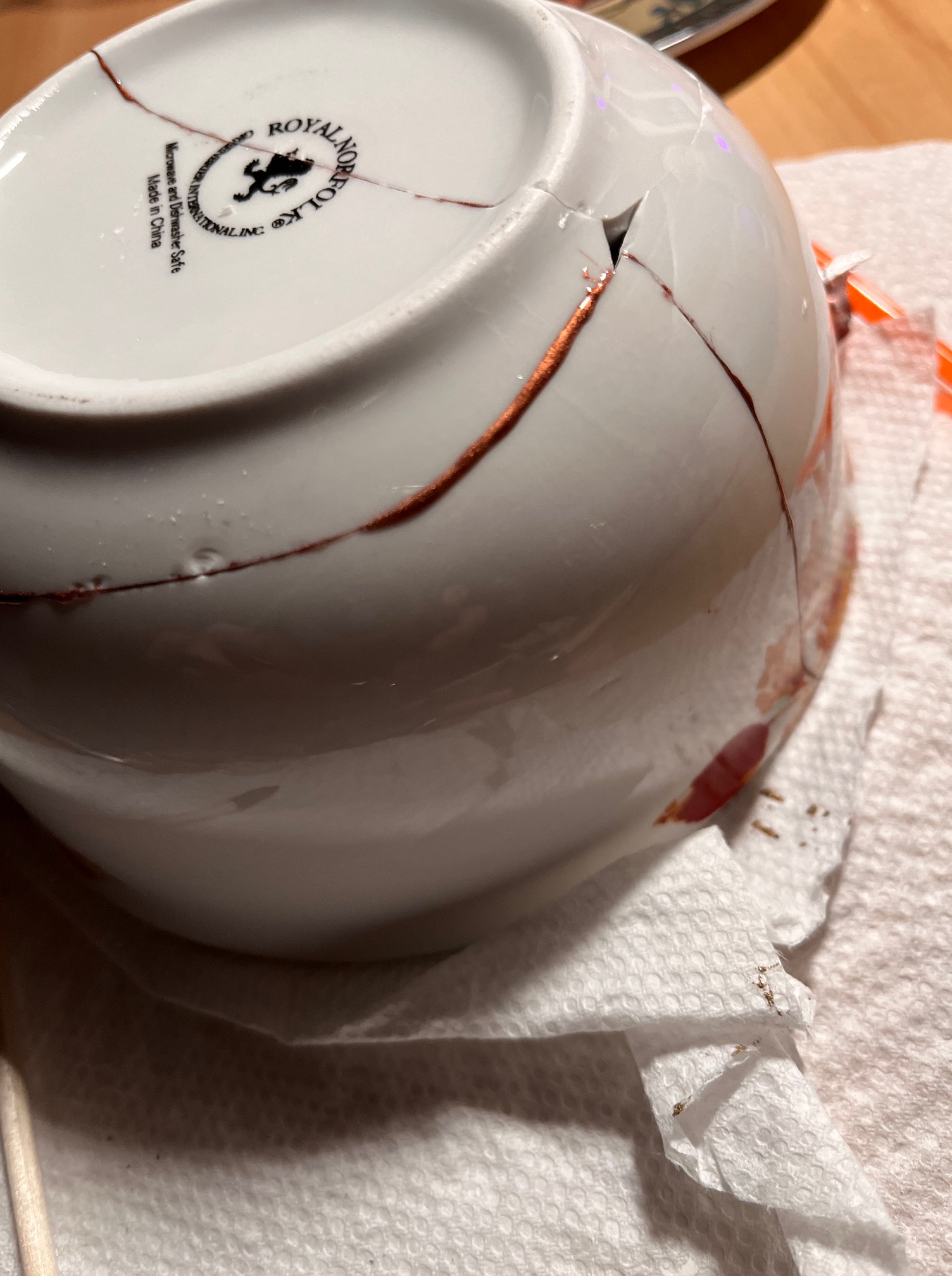
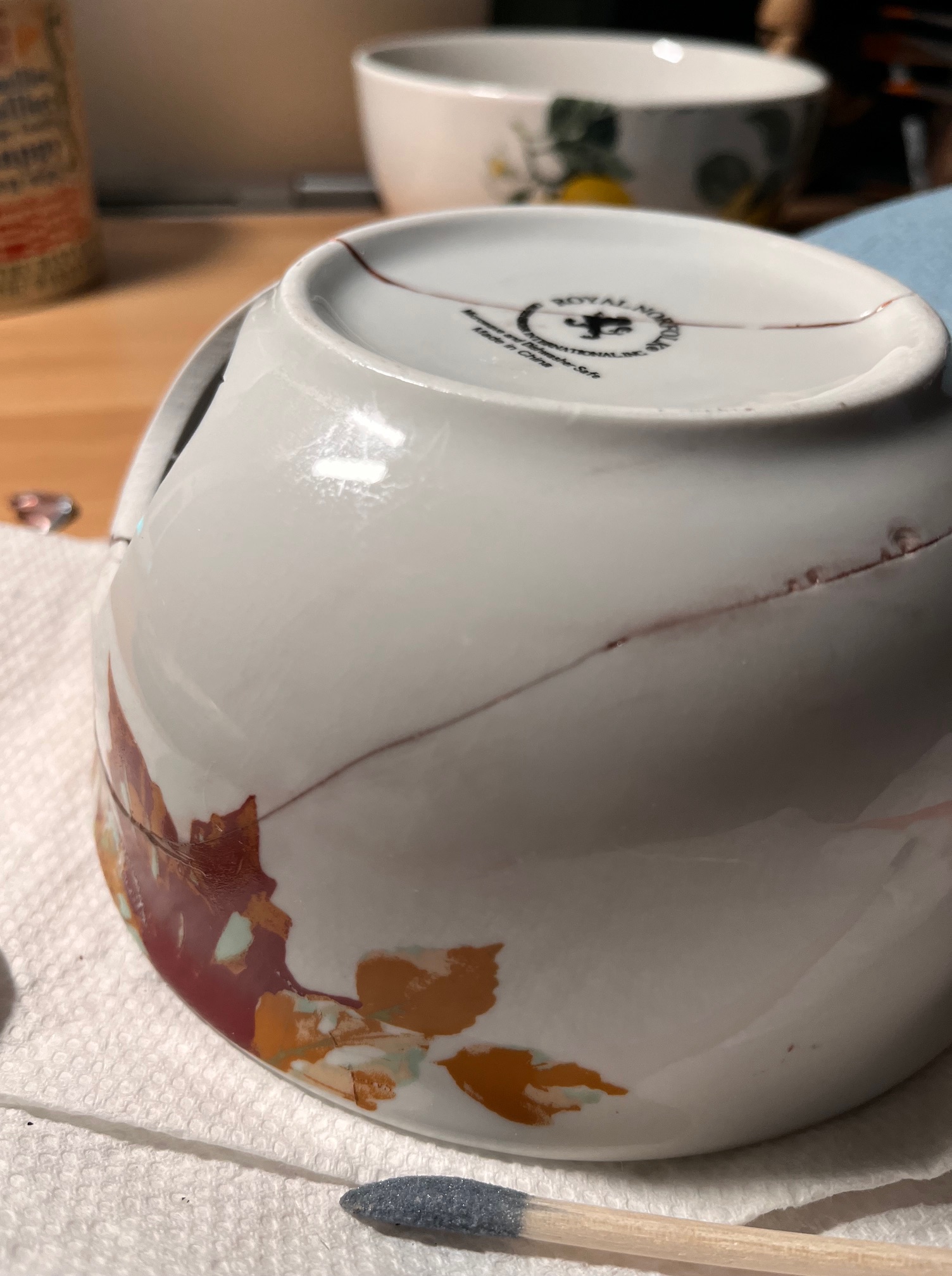
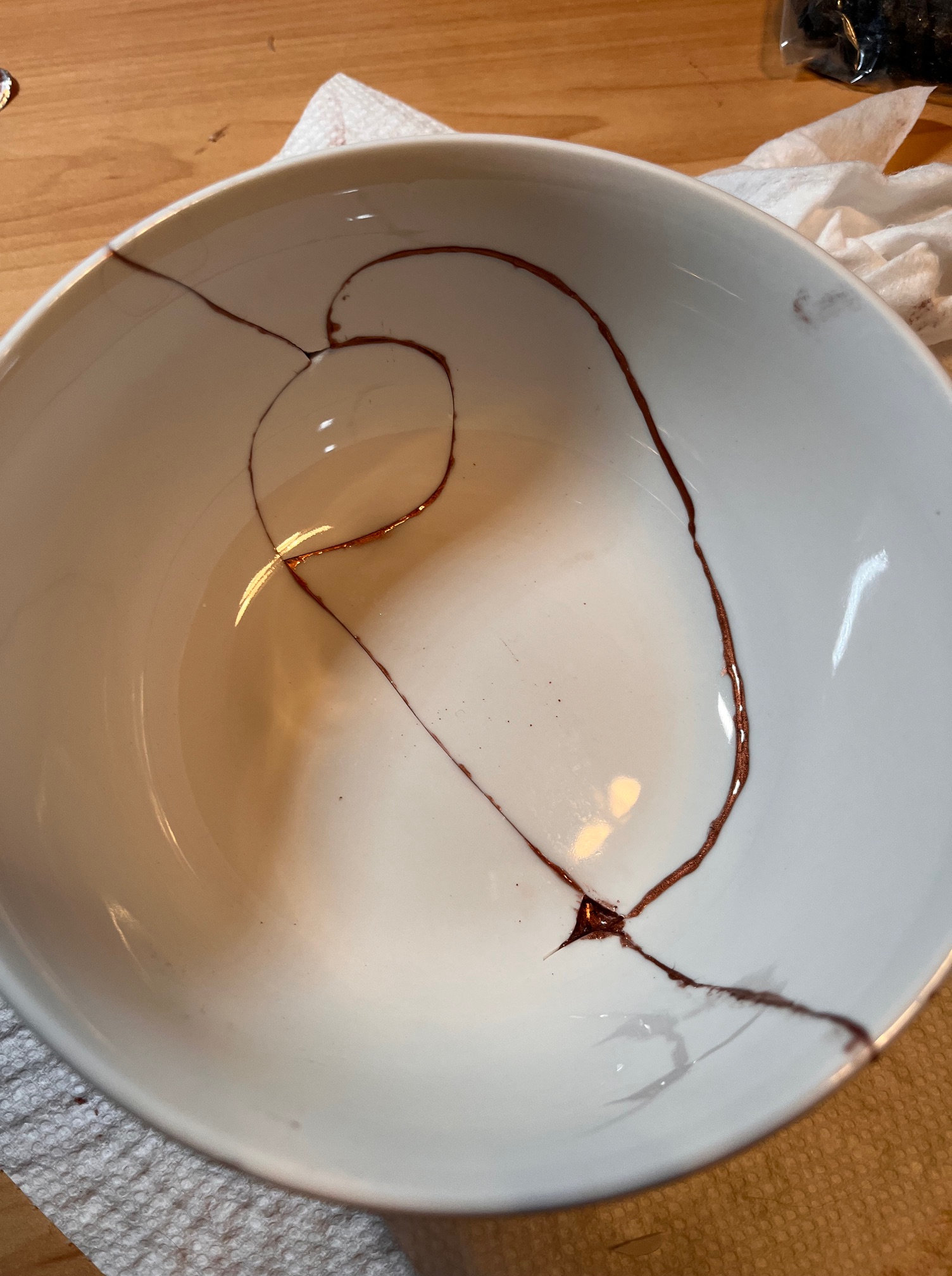
If you’re not familiar, kintsugi, kintsukuroi (金繕い, “golden repair”) is the Japanese art of repairing broken pottery with gold. This form symbolizes embracing imperfections, finding beauty within the mending instead of hiding flaws or tossing away fractured items.
I found myself researching ways to make gold in my home to “fix” small items.
I felt like a magician.
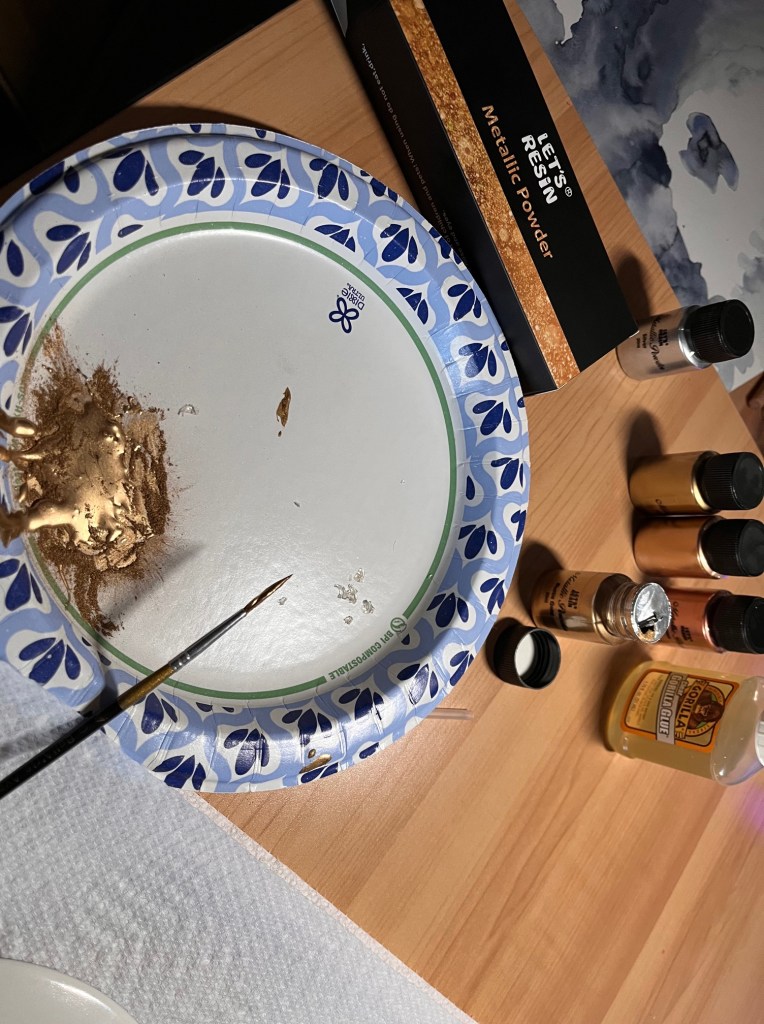
I poured through a number of resin-based products with zero or little mishap, but the end result would often malfunction or fall apart.
I learned that what mattered most was not only the “content,” but the brand. Gorilla Glue and Let’s Resin worked best.
NOTE: You can download my instructions at the end of this blog.
I felt like a scientist (I may or may not have donned goggles) as I brushed on product, realigned edges, filled in gaps. The product always ended up less-than-perfect, but more interesting and, actually stronger, once finished.
Which felt a lot like life.
I love imperfections, accidental misspellings, one nipple a little lower than the other, a thick waist, a crooked tooth. I love pushing against social pressure to look a certain way, dress a certain way, act a certain way (especially “your age”) simply to feel a sense of belonging.
It took me a long time to arrive here, this place of love.
I struggled with approval-need-addiction a good amount of my life. I chameleoned into what my abusers demanded, what the military expected, what a husband desired to the point I lost myself. I spent the last five years purposefully isolating because I thought I needed to heal from so much damage.
What I needed was to time with myself.
Even though I’m no longer in “hibernation,” I now know that alone time for lengthy time is a necessary part of my growth.
I shared some of this experience, including my kintsugi practice, with my friend Esther. After, she asked if I would teach the art form to the Jewish Women’s Circle at Chabad.
No problem, I said.
We only need a few items, I said.
Lucky for me, my friend and colleague, Court Harler arrived (not for my class, but for Treefort) and offered to help me set up.
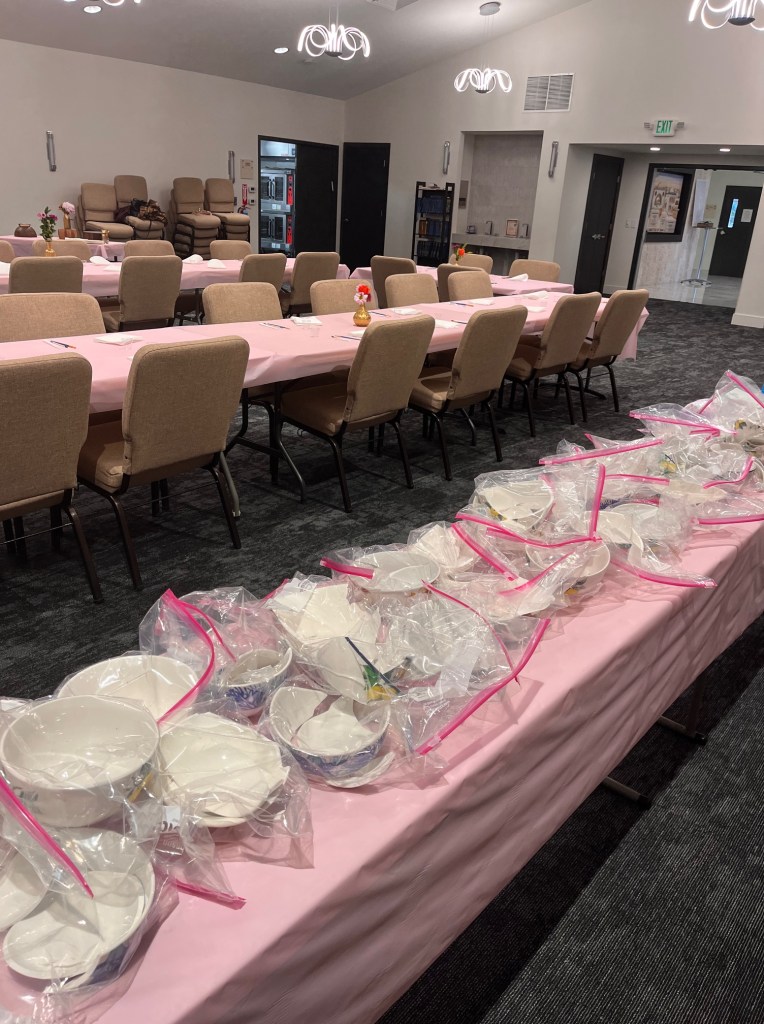
We needed 30 broken items. I bought bowls at a Dollar Store
Court and I may or may not have arm wrestled over breaking bowls because this part of the set up felt the most cathartic.
I highly recommend visiting a Wreck Room.
(You’re welcome.)
We put together individual kintsugi kits.
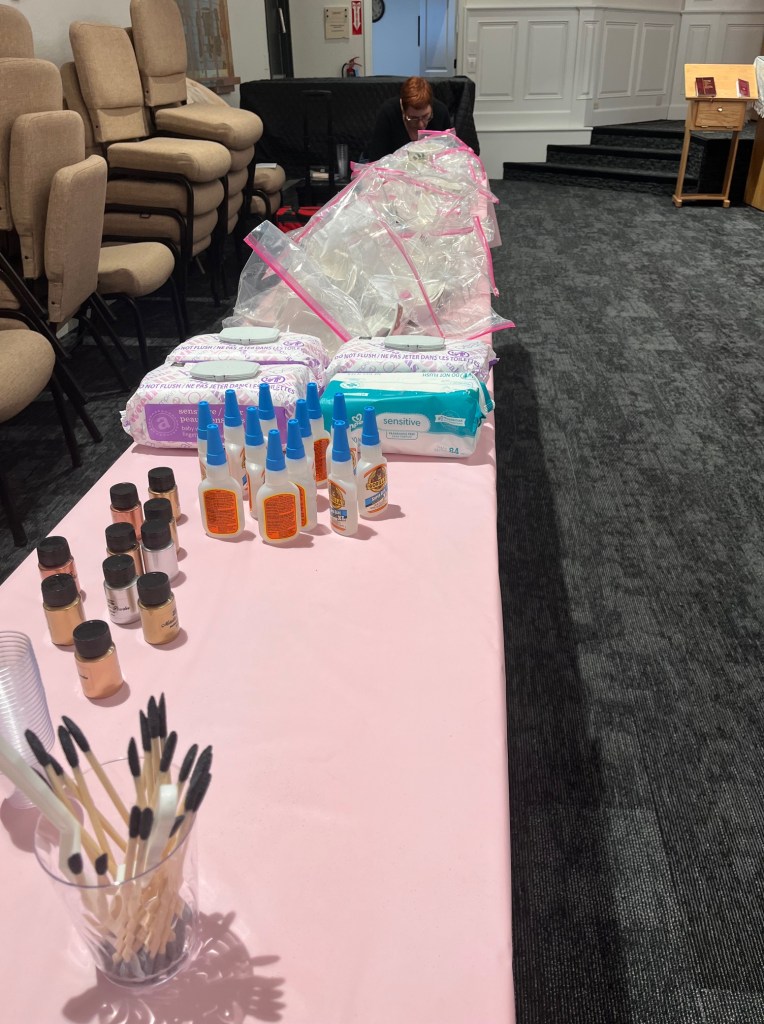
We placed extra products on a table, including small art files and baby wipes.
On a side, I could write a self-help book on the two thousand household uses for baby wipes.
I could also pen a sequel on the three thousand household uses for glue guns.
(Sorry. Different stories for different days.)
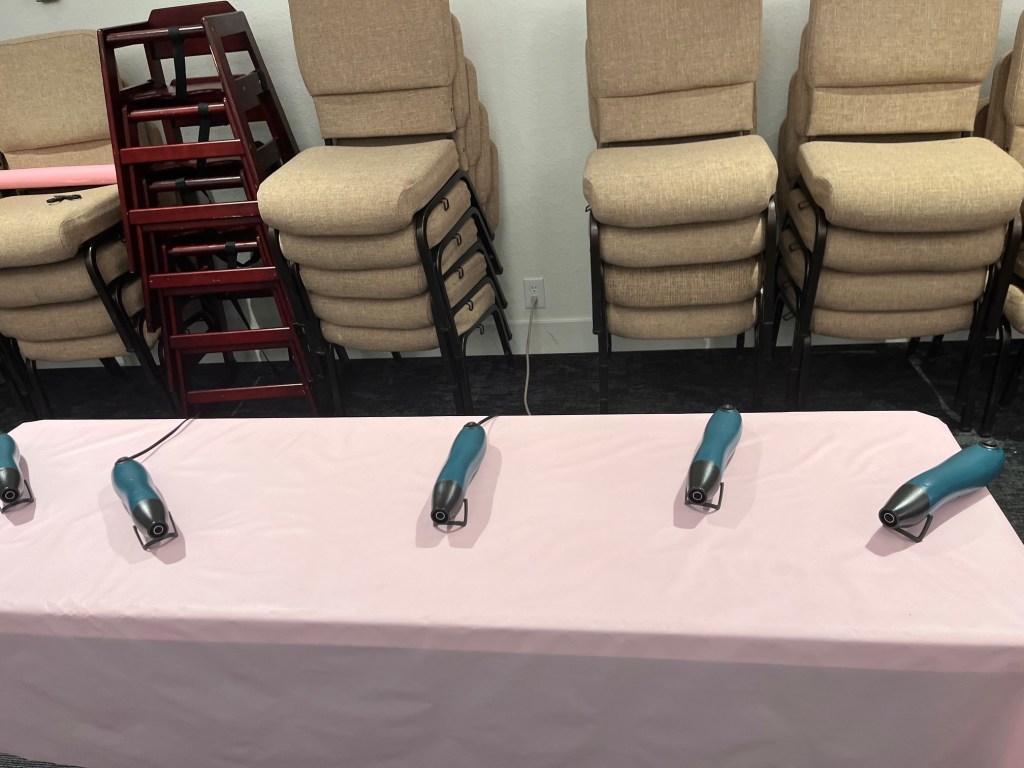
One of my favorite art appliance is a mini heat gun. If you’re also a watercolor artist, you know why.
These little pups are great for phone repairs, embossing, paint/seal drying, candle making, epoxy resin, and shrink wrap too.
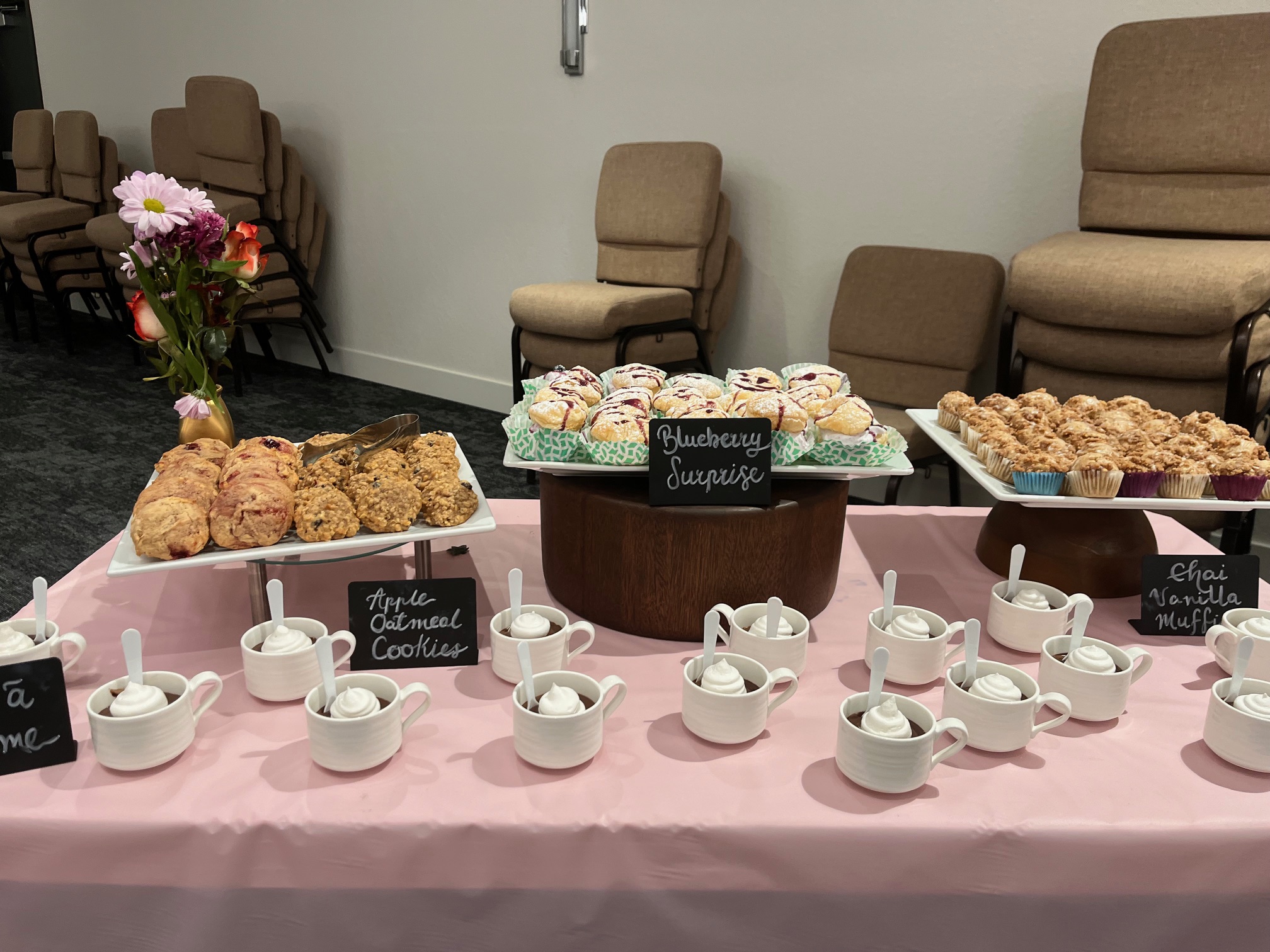
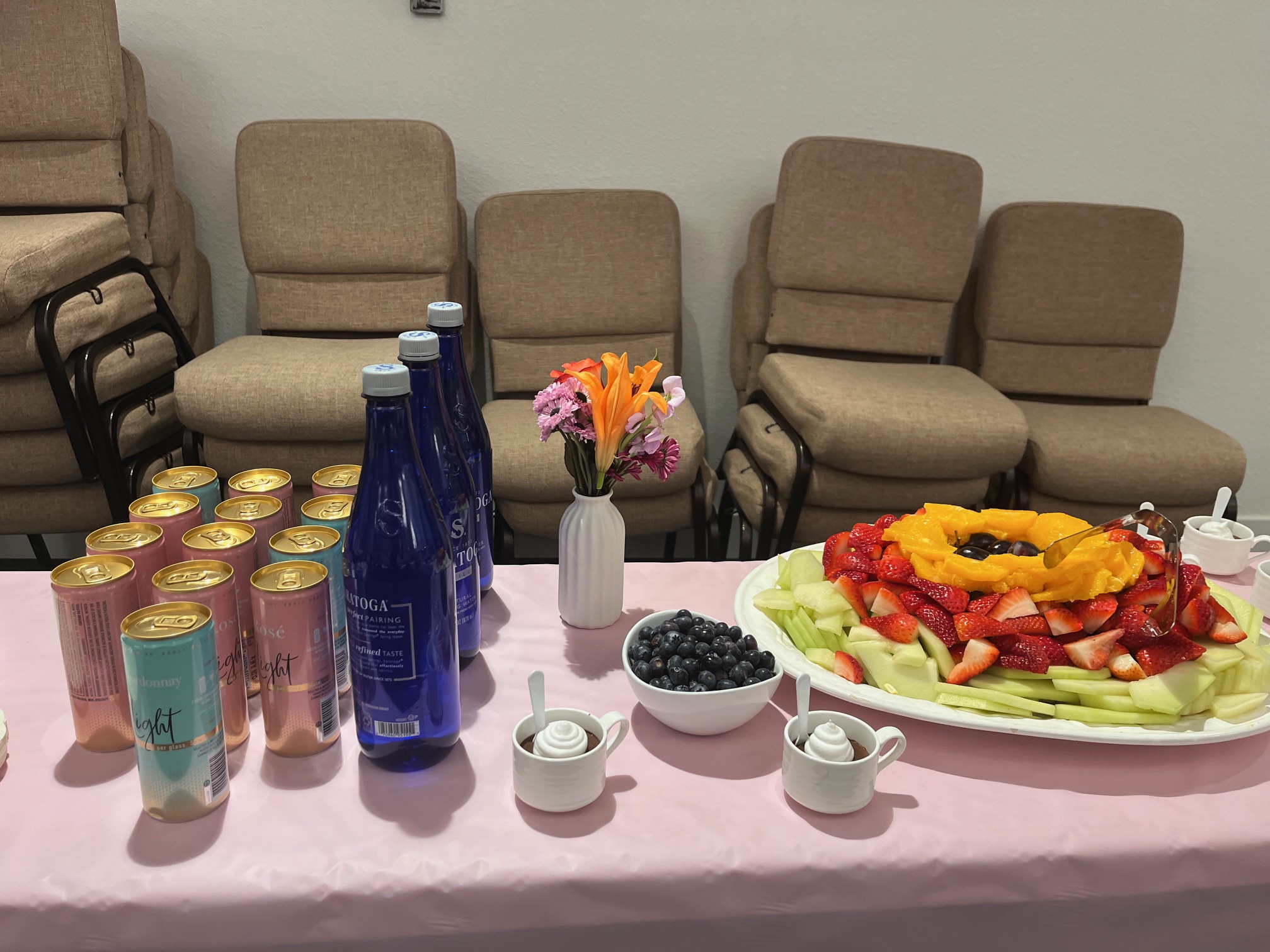
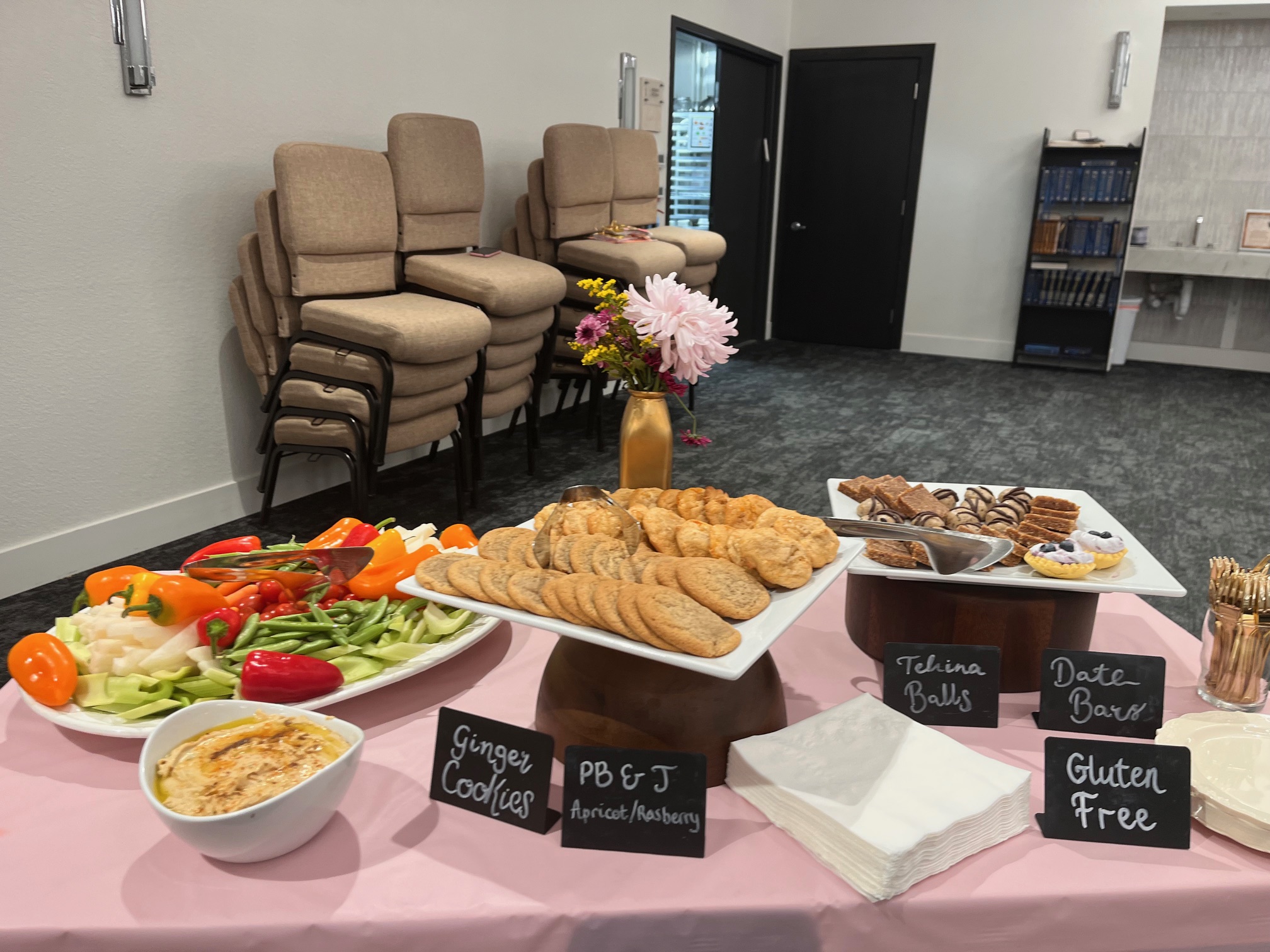
We needed food, which Esther took care of in her usual brilliant capacity.
I began the workshop sharing all the great benefits of kintsugi and then invited the participants to gather ’round me as I demonstrated how to mix their resin with glue for best effect. At home, I used paper plates for my mix. For the workshop, I had purchased small plastic containers for each participant. Withing a minute, the mixture smoked and then the entire little container began melting in my hand.
Here’s where my military training combined with a lifetime of single-motherhood kicked in.
That’s unfortunate, I said.
At the time, I thought the “challenge” was the combination of the plastic container with the ingredients.
Do you have paper plates? I asked Esther. No. Only a plastic variation, which I thought would not work.
How about an old cardboard box? I asked.
We broke down the box and gave participants small sections to “mix” their potions on.
The resin burned through. Participants re-gathered.
No worries, I said.
Let’s brush on only the glue onto the crack. Add the powdered resin to the glue. Quickly push the chunks of bowl together.
This worked.
Sort of.
One significant aspect of kintsugi, as in many Japanese methods, is the slow and mindful process. We lost this because the resin “heated” and then hardened almost immediately. Still, the bowls re-fit and repaired.
Later, I’ll think about my reactions, my way of bringing a solution to the surface and when one way doesn’t work, I’ve two or five more ideas. This is not a super power. This is a mindset. A choice. A way of living.
Once home, I needed to sort out what happened. I wondered why I couldn’t replicate my home experience in a different setting. I soon realized that I’d purchased Gorilla Glue super glue for the workshop. Apparently, the super glue product is not the same as the plain Gorilla Glue and when it comes to science, one atom off makes a difference.
I felt lucky that no one lost a lash.
I re-did the workshop experiment in the privacy of my home and found success (and how much I loved a broken bowl with a “hole” to mend).
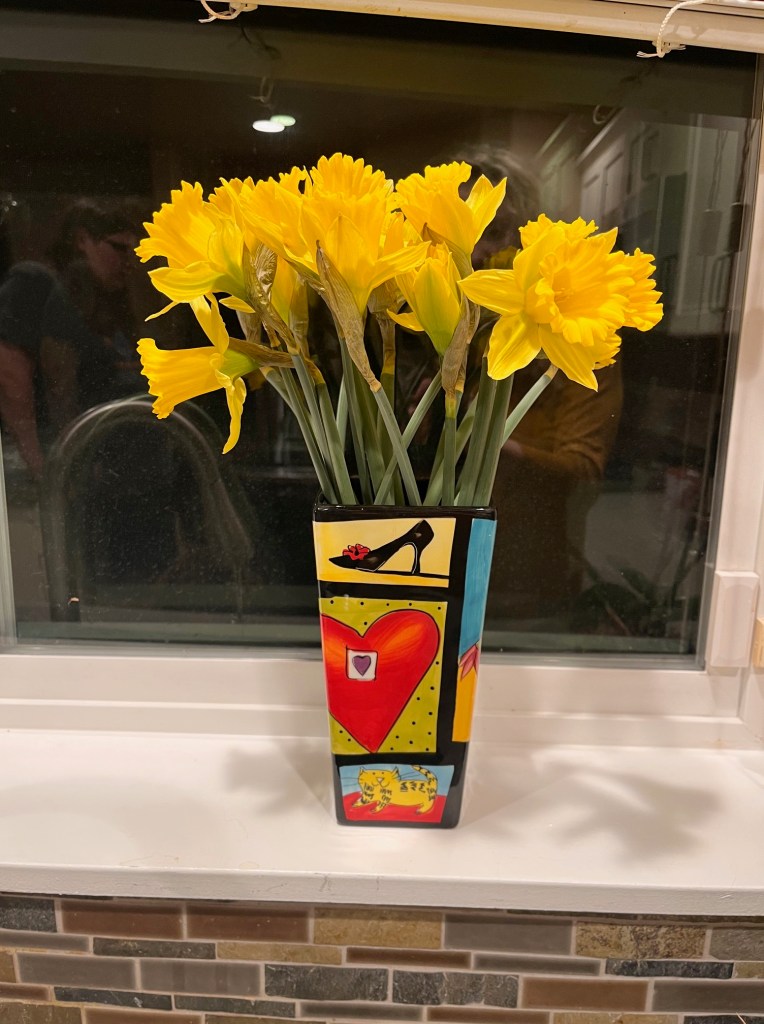
Court bought me flowers.
I placed them in a kintsugi-repaired vase on my kitchen sill.
I know I need kintsuigi in my life, in my attitude.
And I’m thinking about how much we need kintsugi in the world.
Kintsugi reminds us that we can transform difficult experiences into opportunities and resilience. Reminds us that each “break” is unique and, instead of replacing an item (or person), this 400-year-old art technique highlights our “scars” as part of the design. Reminds us that sometimes in the process of repairing broken things, we create something more unique and beautiful.
Downloadables for Kintsugi
Disclaimer: I am not a kintsugi expert and if you use my ideas, techniques, methods and damage anything in the process, I am not held liable. In fact, I’m not an expert at anything and all that I share is simply that: a sharing.
Discover more from Rebecca Evans
Subscribe to get the latest posts sent to your email.

I’ve never heard of “kintsugi” before. Very interesting…
LikeLike
I’m so glad to intro this art form into your life. Would love to hear from you if you dive in.
LikeLike